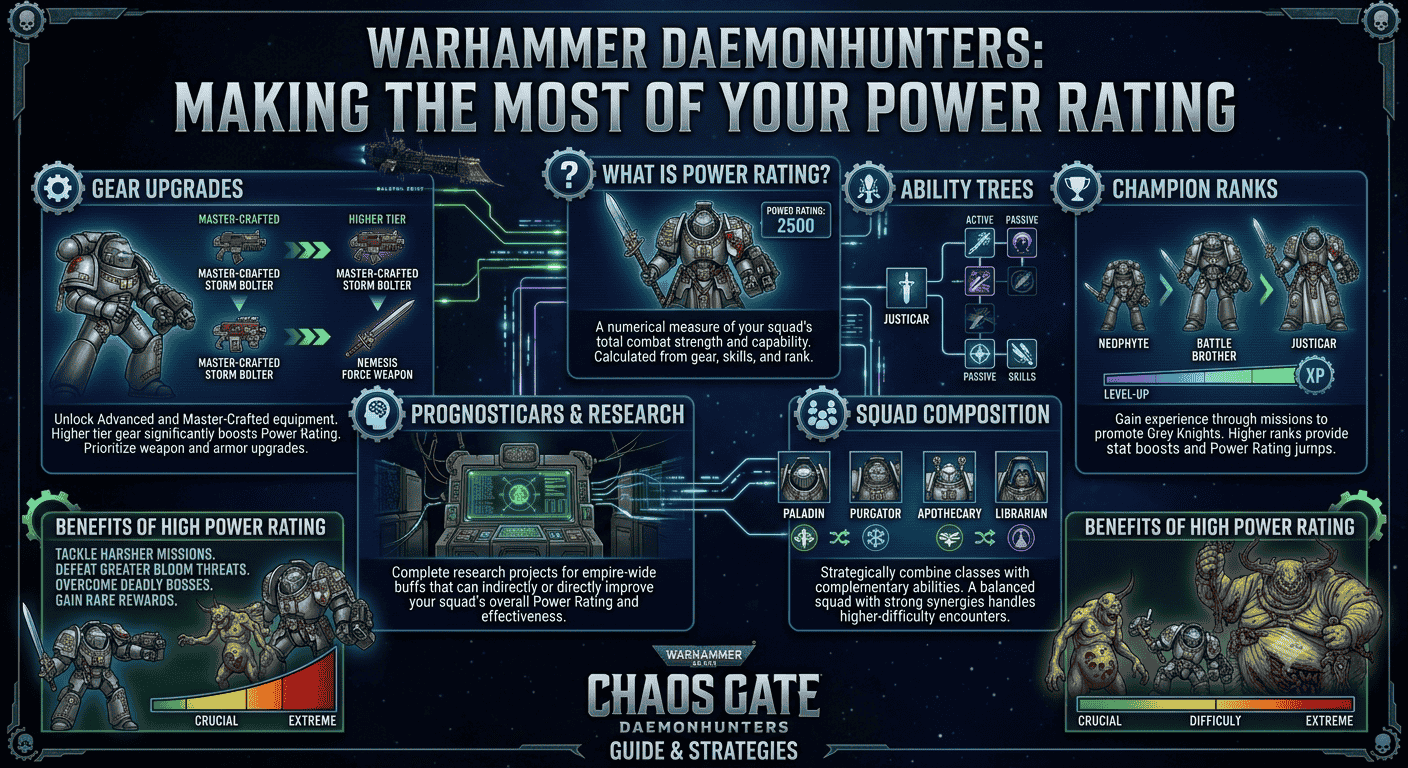
Understanding the Daemonhunters Power Framework
Power Rating is Warhammer 40K’s simplified army-building system, where each unit has a flat PR value regardless of the weapons or upgrades you give it. Points-based play, by contrast, charges you for every bolt pistol and teleporter. That distinction matters more for Grey Knights than almost any other faction, because Daemonhunters units are heavily upgrade-dependent by design. A Strike Squad with default gear plays very differently from one loaded with psycannons, but in a PR game they cost the same.
That’s the core tension. PR flattens the cost curve in a way that punishes factions who pay a lot of points for marginal upgrades, and rewards factions whose base units are already efficient. Grey Knights sit in an interesting spot: their base units are genuinely capable, but several of their best weapons cost a meaningful chunk of points that simply disappear in PR format. Psycannons, Incinerators, and Nemesis force halberds all have points costs that don’t show up in PR. In practice, this means a well-equipped Daemonhunters list can be meaningfully undercosted in PR games compared to matched play.
The divergence is sharpest with Paladins and Terminators, where upgrade costs in points are high enough that their PR value undersells what you’re actually fielding. Dreadknights are the inverse case worth watching — they look efficient on PR, and mostly are, but their points cost tells a more complicated story depending on loadout.
Understanding this gap is what separates a PR list that looks powerful from one that actually performs. The rest of this guide lives in that space.
Building a High-Power List: Core Force Selection
The Patrol detachment is where most Daemonhunters PR lists start, and for good reason. It asks the least of you in terms of mandatory slots, which means fewer filler picks dragging your efficiency down. A Battalion can work if you’re pushing toward higher PR thresholds and want the extra CP, but filling those Troops slots with anything other than Strike Squads usually represents a small loss in output per PR spent.
Brotherhood choice matters more than it might first appear. The Brotherhood of Psykers gives every non-named unit an extra Smite-equivalent, which has real compounding value when your list is already dense with casters. Brotherhood of Prognosticars leans into Warding Staves and damage mitigation, which suits a Paladin-heavy build trying to make each model count longer. Neither is universally correct — it depends on what your list already does well.
The PR-to-points gap is most visible in the core infantry comparison:
Strike Squads sit at PR 6 for 5 models and land around 90 points — reasonable alignment, and they’re rarely a trap pick.
Purifiers price similarly in PR but tend to cost slightly more in matched play, which makes them a mild efficiency gain in PR formats if you want the extra Cleansing Flame output.
Paladins are where things get interesting. Their PR is steep (PR 9+ for a minimum squad), but their matched-play points cost is proportionally higher still. In PR games, they actually represent better relative value than their reputation suggests.
Terminators sit between Strike Squads and Paladins in most metrics and are often overlooked, but their durability-per-PR is solid for holding objectives.
Heavy Hitters Worth Their Power Investment
The units that actually justify their Power Rating cost in a Daemonhunters list are a shorter list than you might expect.
Nemesis Dreadknights are the clearest win. Their PR sits high, but what you’re buying is genuine multi-role utility: close-range firepower, melee threat against anything short of a Knight, and the mobility to actually get there. In PR-format games where you’re not paying points-granularity costs, the Dreadknight’s flat PR often undersells how much table presence it delivers per “slot” of your budget.
Draigo is similar. His raw statline and the buffs he extends to nearby units mean the PR you spend on him is functioning at a multiplier. He doesn’t just contribute his own damage output — he amplifies everything around him. That’s hard to replicate elsewhere in the roster.
Paladins are worth including, with a caveat. A small unit, three to five models, punches well above its PR. Where players go wrong is doubling or tripling down on them, which we’ll cover in the mistakes section. The unit itself is efficient; the over-reliance isn’t.
The honest underperformers: Purifier squads look appealing because of Cleansing Flame and their psychic access, but their PR cost assumes you’re getting ideal activation windows that PR-format list-building often doesn’t set up cleanly. Brotherhood Champions similarly carry PR costs that reflect their lore status more than their practical table contribution in lower-model-count formats.
When you’re budget-constrained, go Dreadknight first. Everything else is negotiable.
Stacking Psychic Power for Maximum Output
Psychic output is where Grey Knights genuinely diverge from other elite factions — you’re not just hoping to get a cast off, you’re building an engine. The question is how much of your PR budget that engine deserves.
The Librarian is the obvious starting point. He brings extra discipline access and the flexibility to pull from multiple power lists, which matters when you’re tailoring for a specific matchup. Brotherhood Champions are cheaper in PR terms but narrower — their powers skew toward melee threat multipliers, so they earn their place in aggressive builds rather than as general-purpose casters.
On Smite: yes, you can stack it, and yes, it degrades. The mortal wound output drops off after the second or third cast in a phase, which means a list built around four psykers all throwing Smite is burning PR on diminishing returns. Two reliable casters with varied powers will almost always outperform a Smite-farm list at the same power level.
Inquisition Allies and Power Efficiency
Adding Inquisition allies to a Daemonhunters list is genuinely tempting — and occasionally correct — but it’s a decision that deserves more scrutiny than it usually gets.
The core tension is this: Inquisitors themselves are cheap in PR terms, often sitting at 4–5 PR for a reasonably kitted character who brings a psychic power, a shooting attack, and an aura ability. For that cost, you’re getting a second psyker on the board and some flexibility in wargear loadout that Grey Knights characters don’t offer. If you need a cheap way to hit a PR threshold without bloating your elite core, a stripped-down Inquisitor is one of the cleaner answers.
Acolyte retinues are where things start to slip. A small squad can look efficient on paper — low PR, bodies on the board, some shooting utility — but their actual combat output is minimal, and they tend to die to almost anything that looks at them. You’re not adding tactical power, you’re adding PR weight and something your opponent can score secondaries off. That’s a bad trade.
The Inquisitorial units that justify their inclusion are the ones that do something your Grey Knights genuinely can’t replicate cheaply: board presence on objectives, cheap action monkey bodies, or access to specific stratagems that only trigger with Inquisition keywords. An Ordo Malleus Inquisitor in Terminator armour, for instance, is PR-heavy but can hold his own in a fight and frees up your actual Paladins to push forward.
The honest rule of thumb: if you can’t explain what the Inquisitorial unit does that your core force doesn’t already cover, cut it.
Stratagems and Command Points at High Power Levels
CP generation doesn’t change based on whether you built your list in PR or points — you still start with a fixed pool determined by detachment structure and any warlord traits or relics that add to it. What does change is how much work each CP has to do. PR lists tend to run fewer units than their points equivalents, which means less redundancy and more pressure on stratagems to paper over gaps. Every CP you spend needs to earn its keep.
That makes stratagem selection more consequential than it might be in a larger, more forgiving force.
Psybolt Ammunition is the obvious priority. Paying 1 CP to add AP-1 across a unit’s shooting in a phase costs very little relative to the damage spike it creates on Strike Squads or Purifiers who were already hitting reasonably hard. On a 10-man Strike Squad targeting a mid-armour unit, it’s a meaningful swing. The timing window is short, so you’ll want to pre-identify your target before the shooting phase opens.
Tide of Shadows is more situational but genuinely powerful when your elite units are exposed. Giving a unit -1 to hit for the cost of 1 CP can keep a Paladin squad or Draigo alive through a combat phase where they’d otherwise eat enough mortal wounds or volume fire to crumble. In a PR-heavy list where losing one unit can unravel your entire gameplan, that defensive buffer has real value.
The broader framework: hold CP for reactive stratagems first, spend offensively only when you have the activation window locked down and can guarantee the payoff.
Common Mistakes When Chasing High Power in Daemonhunters
The most common trap Grey Knights players fall into is treating “high power” as a synonym for “more elite infantry.” It isn’t, and that misread costs games.
Paladins are the obvious culprit. They’re genuinely powerful, but stacking them does something insidious to your list: it concentrates your power budget into a small number of expensive bodies while leaving huge sections of the board uncontested. Your opponent doesn’t need to kill Paladins to beat you — they just need to score objectives you can’t reach. A list with four units of Paladins and nothing else is a PR floor that collapses against any army with actual mobility.
Transports deserve more credit than most Daemonhunters players give them. Razorbacks and Land Raiders sit at relatively modest PR costs compared to what they actually do for your force. A Land Raider Crusader doesn’t just deliver Terminators — it keeps them alive long enough to matter, absorbs dedicated anti-elite firepower, and holds ground on its own. Players who skip transports to fit one more infantry unit often end up with neither board coverage nor survivability.
The action economy issue runs deeper than it looks. Grey Knights have tremendous output per model, but objective scoring, secondaries, and mid-board presence all require bodies in positions. One Terminator squad and a Dreadknight can’t be in three places simultaneously. You need units that can push out, screen, and contest — not just units that can delete whatever they touch. High power in Grey Knights means efficient coverage, not the most expensive possible datasheet stacked four times over.
Practical Checklist: Building a High-Power Daemonhunters List
Start with your anchor unit, because everything else gets built around it. For most Daemonhunters lists, that’s either a Nemesis Dreadknight or Draigo — something with enough raw output that opponents have to respond to it. If your anchor dies turn one because you had no support layer, the list collapses. Pick it first, then protect it.
Once the anchor is set, build the support layer. This usually means a Strike Squad or two for objective holding and action economy, plus whatever characters synergise with your anchor. Brotherhood of Psykers buffs compound here, so make sure your support units are actually benefiting from proximity — don’t just scatter them across the board and hope for the best.
Psychic density comes third. Decide how many casters you actually need to sustain output across three or four turns without running dry on relevant powers. Two or three dedicated psykers is usually the ceiling before you start cannibalising model count for diminishing returns.
Mobility last. Check whether your elite units can actually reach the objectives they need to control. If everything in your list tops out at a 5″ move, you probably need a transport. Razorbacks are PR-efficient enough that there’s rarely a good reason to skip them entirely.
Before you lock the list in, run three quick checks. Does your force cover enough of the board, or are you ceding entire flanks? Do you have at least 3 CP banked for the stratagems that make your key units work? And if your anchor dies early, is there a secondary threat that can take over — or does the list just stall?
Playing High-Power Daemonhunters: In-Game Priorities
Low model-count lists punish deployment mistakes more than almost anything else. With Grey Knights, you don’t get second chances on positioning — if a unit walks into a bad spot in turn one, you’ve already lost a significant chunk of your force. Keep your heaviest hitters out of line-of-sight during setup wherever terrain allows, use your Teleport Strike options to hold units off the board entirely, and resist the urge to commit everything forward just because your units are tough. Tough isn’t invincible.
Target priority runs in a fairly clear order: first, anything that generates mortal wounds at scale (Doom, Smite chains from opponent psykers, anything with “exploding” damage output), then anything projecting a debuff aura that nerfs your combat effectiveness. A Grey Knights unit that can’t fight at full efficiency because it’s sitting inside a -1 to-hit bubble is a unit that cost you far more than its PR implies. Kill that source early, even if it means ignoring an apparently bigger threat.
Anti-elite tools are the real tax on this playstyle. Massed mortal wounds can strip Paladins faster than bolters ever could, and debuff stacking — particularly minus-to-wound or minus-to-hit combinations — compounds nastily against a small pool of activations. Your counters are speed and sequencing. Get your psychic phase off before the opponent can screen their support characters, use Tide of Shadows to limit return fire on exposed units, and accept that some games will require you to trade a unit you’d rather keep just to remove the thing that would otherwise dismantle everything else.
FAQ
What is the most power-efficient unit in a Grey Knights / Daemonhunters roster?
Strike Squads. Five models, solid output, and a PR cost that doesn’t punish you for taking multiples.
Is a full Paladin list viable in PR-format games?
Viable, yes. Optimal, no. You’ll have the raw hitting power but almost no board presence, and most PR formats will punish that lack of coverage.
How do Daemonhunters compare to other elite factions at equivalent power levels?
They punch harder psychically than most equivalents, but they’re more exposed to mortal wound spam and debuff-heavy lists than, say, Custodes.
Can you mix Grey Knights and Inquisition in a PR game without losing efficiency?
Yes, if you’re selective. An Inquisitor with a compact retinue adds real utility. Bloated warband builds cost PR without returning much on the table.
What’s the minimum PR for a competitive Daemonhunters force?
Around 50–60 PR gives you enough pieces to function. Below that, you’re too thin on the ground to cover objectives meaningfully.
Do Nemesis Dreadknights justify their power cost in casual vs. competitive play?
In casual play, absolutely. Competitively, it depends on the mission type — they earn their keep in combat-heavy formats and struggle when the game is primarily about scoring actions.
How does the Brotherhood of Psykers rule interact with high-model-count lists?
It doesn’t scale well. The rule rewards elite, focused builds rather than spreading across many smaller units.
What transports should a Daemonhunters player always consider?
Razorbacks first for most builds. Land Raiders if you’re running Terminators or Paladins and need to guarantee delivery.
How many psykers is too many in a PR-limited format?
Three to four casters is the practical ceiling before Smite returns diminish and you’re spending PR on redundancy rather than coverage.
Are there any Daemonhunters units that are dramatically overcosted in PR vs. their actual table impact?
Purifier squads can feel that way in PR formats — their matched-play strengths don’t translate as cleanly when you’re not playing into the points optimisation assumptions they were designed around.
How do Daemonhunters handle horde armies at high power levels?
Psycannons and Dreadknight flamers do the heavy lifting. Without them, you’ll find melee-focused builds struggle to clear chaff fast enough to protect your scoring pieces.
What edition or ruleset does this guidance apply to, and where should I verify currency?
This is written against 10th edition rules and the current Grey Knights codex as of mid-2025. Always cross-reference with the latest Warhammer Community FAQs and your tournament organiser’s specific PR rules before building your list.